



Blog
The Trash Bag Manufacturing Process converts polyethylene resin into finished liners through film extrusion, printing when required, converting, sealing, inspection, rolling, and packaging.
Understanding how trash bags are made gives commercial buyers a clearer view of how film gauge, bag dimensions, seal construction, printing, and packaging are controlled throughout production.
A typical trash bag production line can be grouped into six main steps:
Resin Preparation → Blown Film Extrusion → Cooling & Winding → Printing & Converting → Sealing & Quality Inspection → Rolling & Packaging
Below is a practical breakdown of each stage.
Step 1: Polyethylene Resin and Material Preparation
The trash bag manufacturing process begins with preparing polyethylene resin according to the required product specification.
HDPE, LDPE, and LLDPE are commonly used depending on the required film properties and finished bag specification.
Before extrusion, resin pellets may be combined with color masterbatch for black, white, or other custom-colored film, along with other processing components when required by the specification.
What Materials Are Used to Make Trash Bags?
Most commercial trash bags are produced from polyethylene-based resins such as HDPE, LDPE, or LLDPE.
These materials are supplied as pellets and prepared before entering the extrusion stage. The selected material formulation depends on the required gauge, dimensions, color, and finished product performance.
Step 2: Blown Film Extrusion on the Trash Bag Production Line
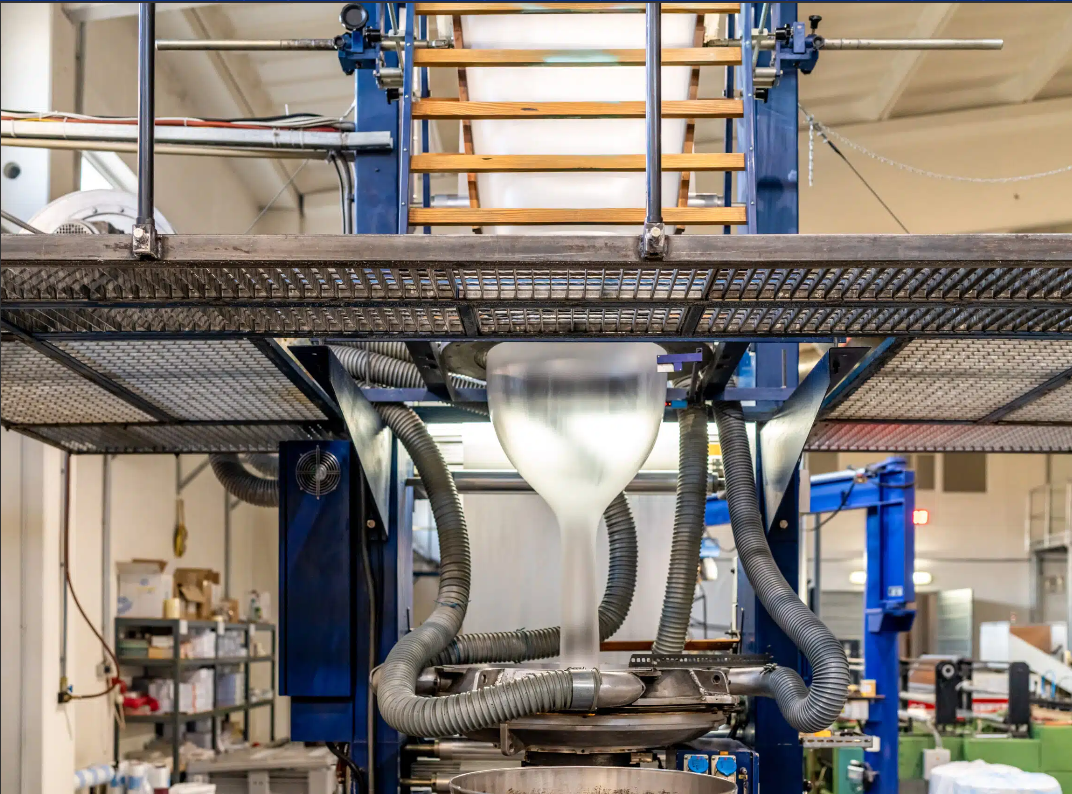
Blown film extrusion is one of the core stages in the trash bag manufacturing process, turning prepared polyethylene resin into continuous tubular film.
Prepared resin pellets enter the extruder and pass through a heated barrel, where the material melts and becomes processable.
The molten polyethylene is then pushed through a circular die to form a continuous tube. Air is introduced into the tube, inflating it into a vertical film bubble.
During this stage, production settings are controlled to maintain:
- Film width
- Film gauge
- Bubble stability
- Film consistency
External cooling air lowers the film temperature as the bubble moves upward before the film is flattened.
What Is Blown Film Extrusion?
Blown film extrusion is a continuous process used to convert melted polyethylene into tubular plastic film.
The tubular structure is well suited for trash bag production because it can later be printed, sealed, perforated, cut, and converted into individual bags or rolls.
Step 3: Film Cooling, Flattening and Winding
After extrusion, the film bubble is cooled and collapsed into a flat tubular structure.
Collapsing frames and rollers guide the film together while maintaining the required width and alignment.
Depending on the bag design, gussets may also be formed during this stage.
The flattened film is then wound under controlled tension into master rolls that can move to printing or directly to converting.
This stage of the trash bag manufacturing process helps maintain consistent film handling before the material enters downstream production.
Step 4: Printing, Bag Converting and Roll Production
In the trash bag manufacturing process, printing is typically completed after film extrusion and before final bag converting, sealing, and perforation when logos, warning text, recycling information, or other graphics are required.
Flexographic printing can be used to apply approved artwork to the polyethylene film.
For more information about specifications, artwork, MOQ, and sample approval, see our custom trash bag process.
After printing, the film moves into converting equipment where it is cut according to the required bag length and configuration.
For trash bags on roll production, converted bags are perforated, counted, wound into rolls, and packed according to the required roll and case configuration.
Depending on the packaging specification, finished bags may be supplied as:
- Coreless rolls
- Rolls with a core
- Individually folded bags
- Flat-packed cases
When Is Printing Added to Trash Bags?
Printing is usually applied after film extrusion and before the film is converted into finished bags.
Applying artwork while the film is still flat makes it easier to control logo position, print repeat, and alignment before the sealing and perforation stages.
Step 5: Sealing, Perforation and Quality Inspection
Sealing closes the bottom of the converted tubular film and forms the finished bag structure.
Common bottom seal styles include:
- Star Seal: Helps distribute load across the bottom of the bag and is widely used for commercial liners.
- Flat Seal: Uses a straight seal across the bottom of the bag.
- Gusset Seal: Uses folded side sections to create additional bottom and side capacity.
For more detail, review our guide to trash bag bottom seal types.
Perforation is also added when individual bags need to be separated from a continuous roll.
Quality checks during the trash bag manufacturing process may include:
- Bag dimensions
- Film gauge
- Seal integrity
- Perforation
- Print position and clarity
- Bag counts
- Packaging requirements
These checks help confirm that finished products remain consistent with the approved specification.
Step 6: Rolling, Packaging and Palletizing
The final stage of the trash bag manufacturing process is rolling and packaging the finished bags according to the required configuration.
For rolled products, the specified number of bags is wound into each roll before the rolls are placed into cartons.
Typical packaging options may include:
- Bags per roll
- Rolls per carton
- Flat-packed quantities
- Custom carton labels
- Barcodes
- Private-label cartons
- Pallet configuration
For distributor and commercial programs, packaging specifications are important because they affect warehouse receiving, inventory handling, and product distribution.
Once packing is complete, cartons are palletized according to the agreed shipping configuration.
Frequently Asked Questions About Trash Bag Manufacturing
How Are Trash Bags Made?
The trash bag manufacturing process starts by melting polyethylene resin and using blown film extrusion to create continuous tubular film.
The film is then cooled, flattened, printed if required, converted to the required dimensions, sealed, perforated, inspected, rolled, and packaged.
What Is the Trash Bag Manufacturing Process?
The trash bag manufacturing process generally includes resin preparation, blown film extrusion, film cooling and winding, printing when required, bag converting, sealing, perforation, quality inspection, and packaging.
The exact sequence can vary depending on bag design, printing, and packaging requirements.
What Materials Are Used to Make Trash Bags?
Commercial trash bags are commonly made from polyethylene resins such as HDPE, LDPE, and LLDPE.
Color masterbatch and other processing components may also be added when required by the product specification.
What Is a Trash Bag Production Line?
A trash bag production line refers to the equipment and production stages used to convert polyethylene resin into finished bags.
Depending on the product, the process can include extrusion, printing, converting, sealing, perforation, rolling, inspection, and packaging.
How Are Trash Bags Made Into Rolls?
During trash bags on roll production, converted bags are perforated between individual bag lengths, counted, and wound into rolls.
The finished rolls are then packed into cartons according to the required bag-per-roll and roll-per-case configuration.
Explore Commercial Packaging Solutions
Understanding the trash bag manufacturing process helps commercial buyers see how approved specifications are carried through extrusion, converting, sealing, inspection, and final packaging.
If you require standard commercial liners or custom production, explore our commercial can liners, learn about our custom trash bag process, or contact us to discuss your requirements.