



Blog
Custom trash bags for commercial applications require clear specification confirmation before production, including size, thickness, material, color, printing, packaging, and order quantity.
Buyers who want to customize trash bags usually already know the basic product requirements. The more important part is making sure those specifications remain consistent from quotation and artwork approval through sampling, mass production, quality inspection, and final packaging.
A typical custom trash bags order moves through five main stages: specification confirmation, MOQ and pricing, printing and artwork approval, sample review, and production with quality control and packaging.
Understanding each stage helps procurement teams reduce specification mismatches, unnecessary revisions, and production delays.
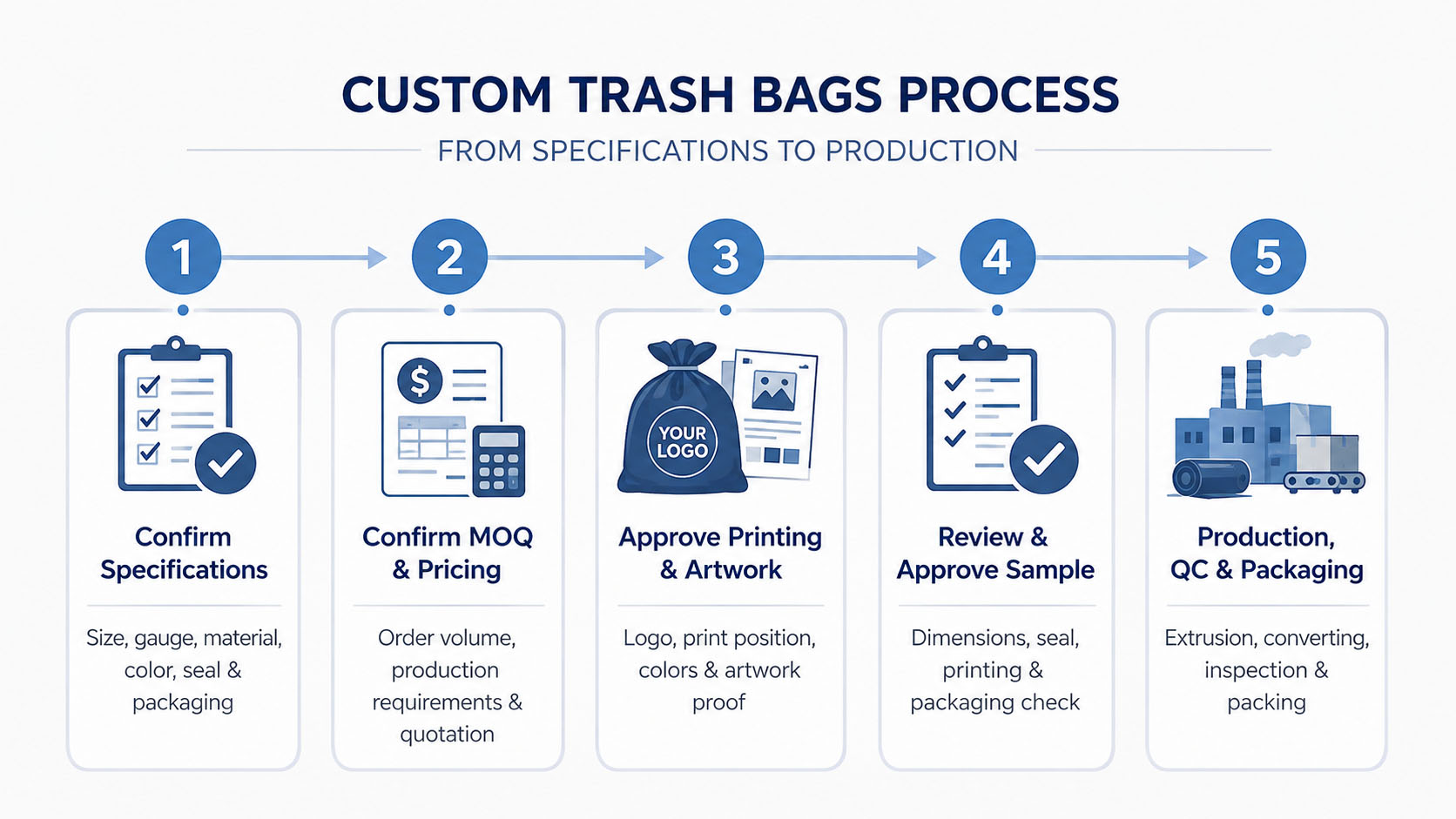
Step 1: Confirm Specifications for Custom Trash Bags
The first stage of ordering custom trash bags is confirming the complete physical and functional requirements of the product. These specifications become the reference point for quotation, sampling, printing, production, and final inspection.
What Specifications Should Be Confirmed Before Customization?
Before requesting a formal quote or starting production, commercial buyers should confirm seven core parameters:
- Bag Size: Width and length in inches, including gusset dimensions if applicable.
- Film Thickness: Required mil or micron specification.
- Material: HDPE, LDPE, LLDPE, or a specified polyethylene blend.
- Film Color: Black, clear, white, or custom Pantone colors.
- Bottom Seal Style: Star seal, flat seal, or gusset seal.
- Order Quantity: Total units or total production volume required.
- Packaging Format: Coreless rolls, flat-packed cases, or custom outer cartons.
These custom trash bags requirements should be reviewed together because changing one parameter can affect material usage, MOQ, pricing, printing, or packaging.
For example, increasing the bag dimensions or film gauge changes the amount of polyethylene required per bag. Changing from standard black film to a custom color may also require additional setup and material preparation.
If the bottom seal has not yet been finalized, buyers can compare the differences between star seal, flat seal, and gusset seal before confirming the specification.
Can an Existing Trash Bag Be Used as a Reference?
Yes. If technical drawings or complete specification sheets are not readily available, sending an existing physical bag sample is often one of the most efficient ways to confirm the required product.
With a physical sample, technical teams can evaluate film gauge, bag dimensions, seal construction, and other visible or measurable specifications.
For buyers replacing an existing product, a sample can help establish the requirements for new custom trash bags without relying only on written descriptions.
However, final dimensions, thickness, material, color, printing, and packaging requirements should still be documented before the order moves into production.
Step 2: Confirm MOQ and Pricing for Custom Trash Bags
Once the custom trash bags specifications are clear, the next step is confirming minimum order quantity and pricing.
There is no single MOQ that applies to every custom order. Production requirements vary depending on bag dimensions, gauge, film color, printing, packaging, and total material volume.
What Affects the MOQ for Custom Trash Bags?
For many full custom film runs, MOQ is managed by production weight rather than by a fixed number of individual bags. Depending on the specification, custom production may start around 3,000 lbs of total material input.
Key factors influencing MOQ include:
- Custom Film Color: Non-standard colors require dedicated setup and raw material preparation compared with standard black or clear films.
- Bag Dimensions and Gauge: Larger or thicker bags use more material per unit, so fewer individual bags may be required to reach the production weight threshold.
- Logo Printing: Printed orders require printing plate preparation and additional printing setup.
- Custom Packaging: Special carton sizes, roll counts, labels, or private-label packaging can affect minimum packing quantities.
Because these factors are connected, MOQ for custom trash bags should be confirmed after the full product specification is available.
Why Can a Specification Change Affect the Price?
Polyethylene product pricing is closely related to raw material usage and production setup requirements.
For example, increasing film gauge from 1.0 mil to 1.2 mil increases resin consumption per bag and therefore changes the per-unit cost.
Similarly, changing from plain film to custom printed trash bags introduces printing plate preparation and additional processing.
Changes to bag dimensions, film color, packaging, or order quantity can also affect the final quotation.
For this reason, pricing should be reconfirmed whenever key specifications change before the purchase order is finalized.
Step 3: Confirm Printing and Artwork for Custom Trash Bags
Printing is one of the areas where custom trash bags require additional confirmation. Company logos, waste classification text, safety markings, or private-label branding need to be prepared correctly before the film enters the printing stage.
What Artwork Is Needed for Custom Printed Trash Bags?
Vector artwork such as AI, EPS, or editable PDF is preferred for flexographic printing on flexible polyethylene film.
To improve print accuracy:
- Define Pantone (PMS) color codes when specific ink colors are required.
- Outline text and fonts within the design file to prevent formatting issues.
- Confirm the required logo size and print position.
- Consider print repeat distances along the continuous film during artwork setup.
If only JPG or PNG artwork is available, it may need to be recreated or converted before printing plate preparation.
What Should Be Confirmed Before Printing?
Before printing setup begins, buyers should review and approve a digital artwork proof.
Key items include:
- Logo Size and Position: Confirm the artwork proportion relative to the bag dimensions and its distance from seals or edges.
- Single- or Double-Sided Printing: Confirm whether artwork appears on one side or both sides.
- Print Colors: Confirm approved ink colors before plate preparation.
- Warning or Identification Text: Confirm asphyxiation warnings, recycling symbols, waste identification, or facility-specific text where required.
For custom trash bags with logo, artwork approval is particularly important because changes after plate preparation may result in additional cost or production delays.
Accurate approval at this stage reduces unnecessary revisions once printing begins.
Step 4: Review and Approve a Custom Trash Bag Sample
Sample review connects the approved custom trash bags specifications with the physical product before mass production.
A sample is not necessary for every project, but it can be useful when specific product characteristics need to be verified before a full production run.
When Is a Custom Sample Needed?
A physical sample may be recommended when an order includes:
- New bag dimensions
- Custom film colors
- New printing artwork
- Private-label packaging
- A product that must closely match an existing bag
- Specifications that have not previously been produced
For simpler projects, an existing stock sample with similar material, thickness, or construction may be sufficient.
The sampling method should depend on which characteristics of the custom trash bags need to be verified.
What Should Be Checked Before Sample Approval?
During sample approval, procurement teams should compare the physical product with the approved specifications.
Typical checkpoints include:
- Dimensions and Fit: Test the sample in the intended waste receptacle to verify width, length, and overhang.
- Seam and Seal Quality: Check bottom seal integrity and overall seam strength under normal use conditions.
- Gauge and Texture: Confirm film thickness consistency and overall film feel.
- Print Clarity: Check ink adhesion, legibility, print position, and alignment.
- Packaging Format: Confirm perforation, bag count, roll format, or flat-fold presentation where applicable.
Approving the sample allows the final specifications and production settings to be confirmed before mass production.
If changes are requested after sample approval, the quotation, artwork, production setup, or sample may need to be reviewed again.
Step 5: Custom Trash Bags Production, Quality Check and Packaging
After sample approval and final specification confirmation, the custom trash bags order moves into mass production.
The main production stages generally include film extrusion, printing, converting, inspection, and packing according to the approved requirements.
What Happens After Sample Approval?
A typical production sequence includes:
- Film Extrusion: Polyethylene resin and color masterbatch are melted and blown into continuous film.
- Printing: If required, the film passes through printing equipment to apply the approved artwork.
- Bag Making and Converting: Continuous film is heat-sealed, perforated, and cut to the specified bag dimensions.
- Inline Quality Checks: Key production parameters are monitored to maintain consistency in dimensions, sealing, film gauge, and print position.
For buyers who want more detail on these stages, the complete trash bag production process explains how polyethylene film moves from extrusion through converting and packing.
Once mass production begins, later changes to size, gauge, printing, or packaging can affect production progress and cost.
This is why the final specifications for custom trash bags should be approved before the production run starts.
What Is Checked Before Custom Trash Bags Are Packed?
Before final packing, finished goods are checked against the approved specification.
Typical inspection points include:
- Bag dimensions
- Film gauge consistency
- Seal integrity and strength
- Printing position and clarity
- Bag counts per roll or case
- Outer carton labels
- Packaging quantities
For private-label or distributor programs, carton markings, barcodes, labels, and pallet configurations can also be checked against the agreed packaging requirements before shipment.
Packaging is part of the final product specification, especially when bags are intended for resale or distribution through multiple warehouses.
FAQ About Custom Trash Bags
What Information Is Needed to Order Custom Trash Bags?
Buyers should provide bag dimensions, film gauge, material, color, seal type, printing requirements, packaging format, and required quantity.
If an existing product is already in use, a specification sheet or physical sample can also be provided as a reference.
The more complete the initial specification is, the easier it is to confirm MOQ, pricing, artwork, and production requirements.
What Is the MOQ for Custom Trash Bags?
MOQ for full custom production may start around 3,000 lbs of material input, depending on the specification.
Minimum quantities can vary based on bag dimensions, gauge, film color, printing, packaging, and other production requirements.
Can I Print a Logo on Custom Trash Bags?
Yes. Custom printed trash bags can include company logos, product identification, waste classification text, warnings, or other approved graphics.
Vector artwork is preferred, and the print size, position, colors, and final artwork should be approved before printing setup begins.
Can Packaging Be Customized for Custom Trash Bags?
Yes. Packaging options may include coreless rolls, flat-packed cases, custom outer cartons, labels, barcodes, and private-label packaging.
Packaging requirements should be confirmed before mass production because changes to roll counts, carton sizes, or labeling can affect production planning and packing quantities.
Finalize Your Custom Trash Bags Requirements
A successful order for custom trash bags depends on confirming the right details at each stage. From initial specifications and quotation to artwork approval, sampling, production, inspection, and packaging, each step should follow the same approved requirements.
If you are ready to submit your specifications, review our commercial can liner options or contact us with your bag dimensions, thickness, material, color, printing requirements, packaging format, and required quantity.