



Blog
30 gallon trash bags are widely used in offices, commercial buildings, kitchens, schools, cleaning operations, and other everyday waste collection environments. However, gallon capacity alone does not tell a buyer whether a liner will actually fit the container or suit the waste being collected.
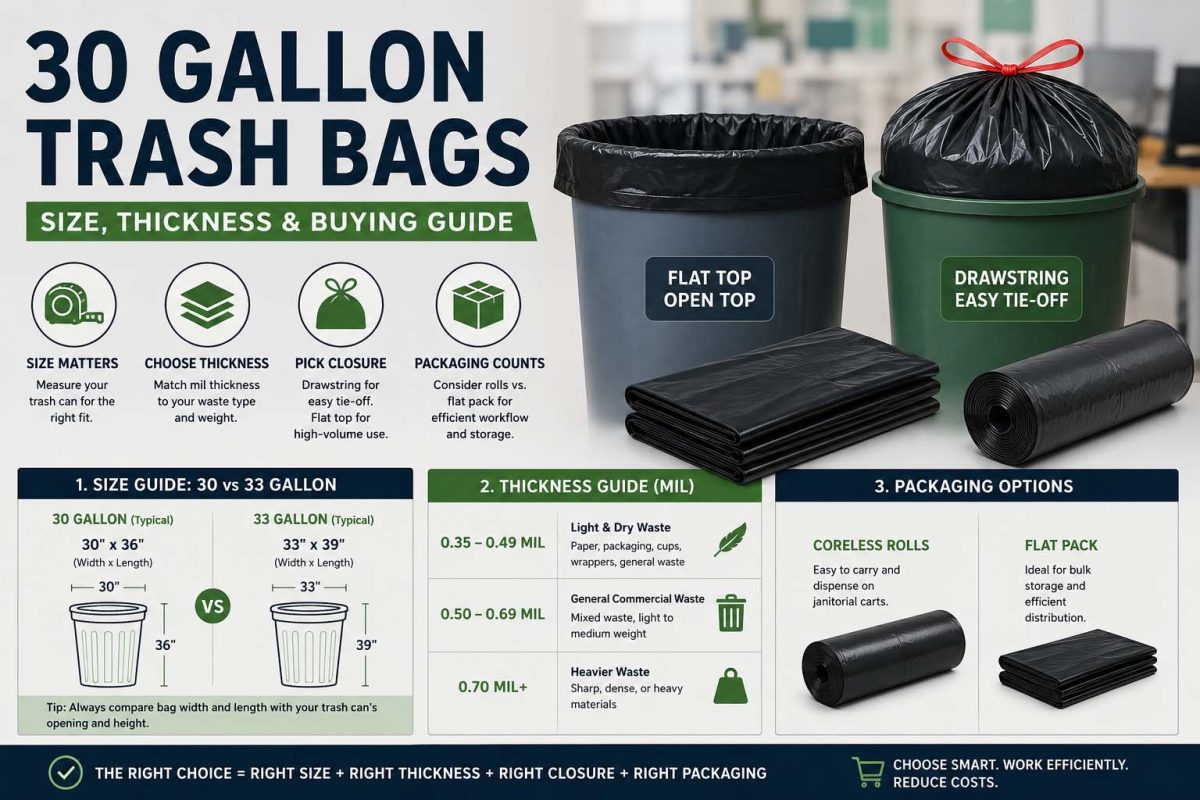
Two 30 gallon trash bags can have different widths, lengths, thicknesses, materials, and closure styles. A 30 gallon can may also work with some 33 gallon liners when the actual dimensions are a better match.
For commercial buyers, the selection process should start with the container dimensions, followed by thickness, waste type, and closure style.
Why Gallon Size Alone Is Not Enough
The gallon number is a capacity reference, not a complete bag specification.
A liner marked 30 gallon can still be too narrow for a wide container or too short for a tall trash can. This explains why bags with the same gallon rating do not always fit the same receptacle.
When comparing 30 gallon trash bags, pay attention to:
| Measurement | Why It Matters |
|---|---|
| Width | Determines whether the liner fits around the container opening |
| Length | Determines whether it reaches the bottom and leaves enough material above the rim |
| Opening | Helps determine whether the liner can cover the top of the container |
| Overhang | Provides extra material for installation and removal |
For repeat commercial purchasing, measuring the actual container is more reliable than choosing by gallon number alone.
Understanding 30 and 33 Gallon Trash Bag Sizes
30 and 33 gallon trash bags are often sold within a similar capacity range. This is why both sizes frequently appear when buyers are looking for liners for medium-to-large trash cans.
However, actual dimensions vary between manufacturers.
One 30 gallon liner may be wider and shorter, while another may be narrower and taller. A 33 gallon bag can sometimes provide a better fit for a particular 30 or 32 gallon container.
The important point is simple:
30 gallon does not describe one fixed bag dimension.
Before ordering 30 gallon trash bags, compare the bag width and length with the actual opening and height of the trash can.
Choosing the Right Trash Bag Thickness
Capacity and thickness are two different specifications.
The same 30 gallon size can be produced in different thicknesses depending on what the bag is expected to hold. In the U.S. market, trash bag thickness is commonly expressed in mil.
1 mil = 0.001 inch ≈ 25.4 microns.
A thinner specification such as around 0.4 mil may work for lightweight dry waste such as:
- office paper;
- lightweight packaging;
- cups and wrappers;
- general low-weight waste.
As the waste becomes heavier or more demanding, buyers can move toward a thicker specification.
The key is not to automatically choose the thickest 30 gallon trash bags available. Thickness should match the actual waste stream.
Material and bag construction also affect performance, so mil should not be evaluated as a stand-alone specification.
Light and Dry Waste
For paper, packaging, and other low-weight waste, a lighter liner can often provide an appropriate specification.
This is especially relevant in locations where bags are changed frequently but rarely contain dense or sharp materials.
General Commercial Waste
For mixed everyday waste, buyers may need more thickness than they would for paper-only applications.
The correct choice depends on what is actually being discarded rather than the gallon capacity of the container.
Heavier Waste
When waste consistently contains heavier, sharper, or more demanding materials, a thicker liner or different material may be more appropriate.
Applications involving construction debris or other demanding loads should be evaluated separately in our Heavy Duty Trash Bags Guide.
Drawstring vs Flat Top 30 Gallon Trash Bags
Another important difference is the closure style.
Drawstring and flat top 30 gallon trash bags can serve similar-capacity containers, but they support different working routines.
| Feature | Drawstring | Flat Top / Open Top |
|---|---|---|
| Closure | Built-in drawstring | Open top |
| Main Purpose | Convenient closing and removal | Simple commercial liner format |
| Typical Direction | Office, hospitality, routine facility cleaning | Janitorial, facilities, warehouses |
| Buying Consideration | Handling convenience | Volume, specification and workflow |
When Drawstring Bags Make Sense
Drawstring bags are useful when staff regularly remove individual filled bags and want a built-in method for closing them.
This can be practical in:
- offices;
- hotels;
- restaurants;
- schools;
- routine facility cleaning.
The main benefit is operational convenience. The drawstring does not determine the bag’s gallon capacity or thickness.
When Flat Top Bags Make Sense
Flat top liners are common in commercial and janitorial applications where a built-in closure is not necessary.
They are frequently considered for:
- cleaning contractors;
- commercial buildings;
- warehouses;
- general facility operations.
For buyers using large quantities of liners, factors such as dimensions, thickness, packing format, and cost per liner may be more important than having a drawstring.
The choice between drawstring and flat top 30 gallon trash bags should therefore be based on how the liner is handled after use, rather than simply on which design appears more convenient.
Choosing 30 Gallon Trash Bags by Application
The same gallon category can serve very different environments.
Offices and Commercial Buildings
Office waste often includes paper, packaging, cups, and other relatively lightweight materials.
Important considerations include:
- correct container fit;
- appropriate liner thickness;
- frequent and easy replacement.
A large container does not automatically require a thick liner if the contents remain lightweight.
Restaurants and Foodservice
Foodservice waste can contain mixed materials and moisture.
Compared with dry office waste, buyers may pay more attention to:
- thickness;
- material;
- bottom construction;
- handling after the bag is filled.
The specification should follow the waste stream rather than the gallon number alone.
Janitorial and Cleaning Services
Cleaning contractors may use large quantities of 30 gallon trash bags across several customer locations.
Their purchasing decisions are often more specification-driven:
- consistent dimensions;
- consistent thickness;
- case packing;
- storage;
- repeatable performance across sites.
Packaging Format Also Matters
For cleaning contractors, the liner itself is only one part of the purchasing decision.
Commercial 30 gallon trash bags and similar 33-gallon liners may be supplied as coreless rolls or flat-packed bags.
Coreless rolls can be convenient for carrying liners on janitorial carts while servicing multiple receptacles. Flat-packed liners can be practical for centralized storage and bulk dispensing.
Buyers should therefore compare not only bags per case, but also:
- bags per roll;
- rolls per case;
- storage requirements;
- how liners are distributed to cleaning staff.
Closure style and packing format are separate purchasing decisions. A flat top bag does not automatically mean coreless roll packaging, and a drawstring bag does not necessarily require a retail-style package.
For high-volume cleaning operations, these details can matter even when the bag size and thickness remain unchanged.
Warehouses and Facilities
Warehouses may generate packaging materials, general commercial waste, or larger volumes of lightweight waste.
A large trash can filled with packaging can require a very different liner from the same-size container used for dense or sharper waste.
Again, size and waste type should be evaluated together.
Material Options
Common polyethylene trash liner materials include HDPE, LDPE, and LLDPE.
| Material | General Direction |
|---|---|
| HDPE | Often used for thinner liners and lightweight waste |
| LDPE | Flexible material used across general applications |
| LLDPE | Often selected where stretch and toughness are important |
Material should be considered together with thickness, dimensions, seal construction, and application.
For a deeper comparison, see our HDPE vs LDPE vs LLDPE Guide.
How to Measure Before Buying 30 Gallon Trash Bags
Before purchasing 30 gallon trash bags, measure the actual trash can rather than relying only on its gallon rating.
Start with:
- Measure the top opening.
- Measure the container height.
- Determine how much liner should extend above the rim.
- Compare those measurements with the bag width and length.
Example: Sizing a Round 32-Gallon Commercial Trash Can
Consider a round commercial container measuring approximately 22 inches in diameter and 27 inches high.
As a starting estimate, the flat bag width needs to cover roughly half the circumference of the container:
22 × 3.14 ÷ 2 ≈ 34.5 inches
For the bag length, add the container height, approximately half the diameter, and several inches of overhang:
27 + 11 + 4–5 ≈ 42–43 inches
This example shows why gallon capacity alone may not identify the correct liner.
A bag labeled 30 or 33 gallon can still be too narrow or too short depending on its actual dimensions. Container shape and the amount of overhang required can also affect the final choice.
For containers with unusual shapes, measure the actual opening rather than relying only on the gallon label.
Common Buying Mistakes
| Common Mistake | Better Approach |
|---|---|
| Choosing only by gallon rating | Check actual bag and container dimensions |
| Assuming thicker is always better | Match thickness to the waste |
| Ignoring closure style | Consider how filled bags are handled |
| Treating all 30 and 33 gallon bags as interchangeable | Compare width, length, thickness and material |
| Ignoring packing format | Compare bags per roll, case packing and distribution method |
Frequently Asked Questions
What size trash bag fits a 30 gallon trash can?
There is no single dimension that fits every 30 gallon container.
Measure the trash can opening and height, then compare those measurements with the liner width and length.
Are 30 and 33 gallon trash bags the same?
No. They are often grouped within a similar capacity range, but actual dimensions can vary.
Some 33 gallon liners may fit certain 30 or 32 gallon containers, but the measurements should be checked first.
What thickness should 30 gallon trash bags be?
It depends on the waste.
Lightweight dry waste may use a thinner liner, while heavier or more demanding waste may require a thicker specification. Material and construction should also be considered.
Are drawstring bags better than flat top bags?
Neither is universally better.
Drawstring bags provide a built-in closure for convenient removal, while flat top bags are widely used in commercial and janitorial operations where a simple liner format is preferred.
What does mil mean for trash bags?
Mil is a plastic film thickness measurement.
One mil equals 0.001 inch, or approximately 25.4 microns.
Choosing the Right 30 Gallon Trash Bags
The right 30 gallon trash bags are selected by more than gallon capacity.
Start by matching the liner dimensions to the actual trash can. Then choose a suitable thickness based on the waste and decide whether a drawstring or flat top design better fits the daily workflow.
For high-volume commercial use, packing format can also affect how liners are stored and distributed.
For commercial buyers, the most useful question is not simply:
“Is this a 30 gallon bag?”
It is:
Do the size, thickness, material, closure style, and packing format match the container and the waste being collected?