



Blog
HDPE vs LDPE vs LLDPE are the three main polyethylene material directions buyers compare when selecting commercial trash bags and can liners. Each material behaves differently in film form, so the right choice depends on waste type, film gauge, bag dimensions, puncture risk, stretch requirements, and bottom seal construction.
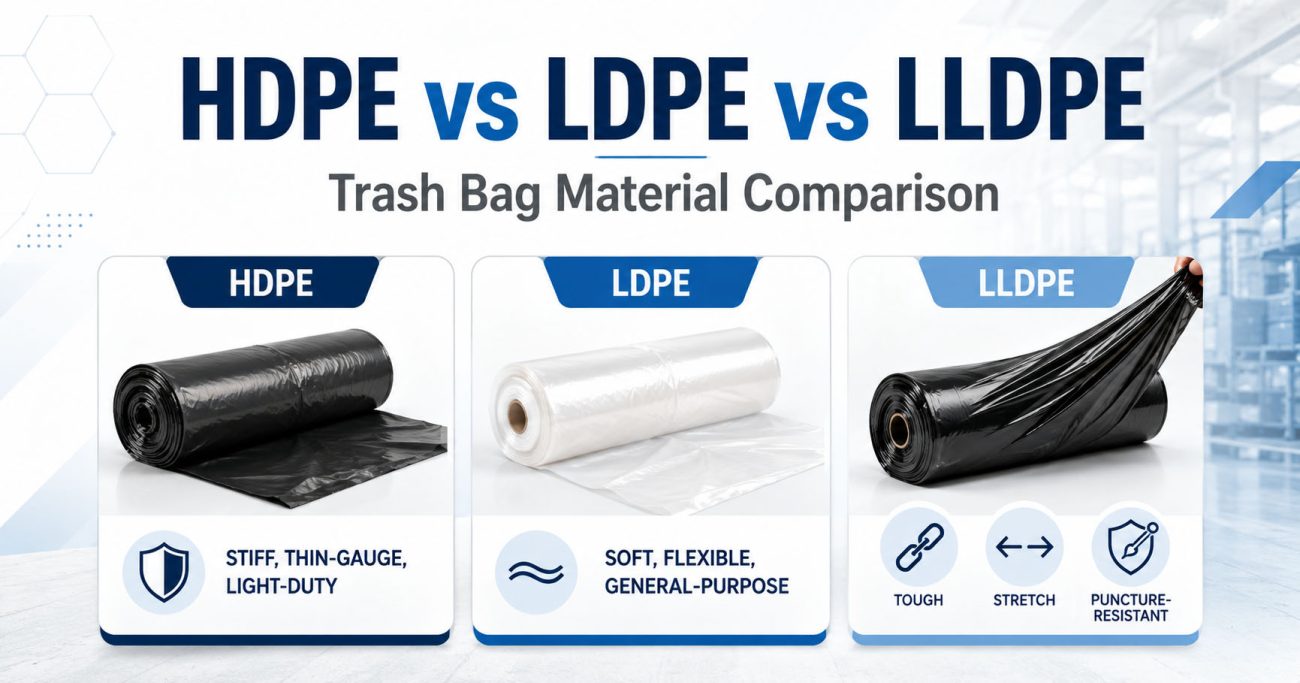
As a practical starting point, HDPE is commonly used for light, non-sharp waste and thin-gauge liners. LDPE offers a softer and more flexible film feel for general commercial applications. LLDPE is often selected when greater toughness, stretch, and puncture resistance are priorities.
When evaluating HDPE vs LDPE vs LLDPE, there is no single resin that is best for every bag. The better specification is the one that matches the load and operating conditions without adding unnecessary material or cost.
HDPE vs LDPE vs LLDPE: Quick Comparison
The table below gives B2B buyers a practical comparison of the three materials.
| Property / Requirement | HDPE | LDPE | LLDPE |
|---|---|---|---|
| Film Feel | Stiffer, crisper | Soft, flexible | Flexible, tough |
| Stretch | Lower | Good | High |
| Puncture Performance | Best suited to light, non-sharp loads | Good depending on gauge and formulation | Typically strong for irregular or puncture-prone loads |
| Tear / Toughness | Depends on grade and gauge | Good general-purpose toughness | Typically very good |
| Thin-Gauge Potential | High for suitable light-duty applications | Moderate | High with suitable formulations |
| Typical Waste Profile | Light, soft, non-sharp | General commercial waste | Heavy, irregular, puncture-prone |
| Typical Use Direction | Office, restroom, paper waste | General commercial applications | Tougher commercial and industrial loads |
This HDPE vs LDPE vs LLDPE comparison should be used as a starting point rather than an absolute ranking. Finished-bag performance also depends on resin grade, resin blends, gauge, dimensions, seal style, and the waste stream. application requires HDPE, LDPE, or LLDPE, we offer custom gauge engineering to match your specific industrial requirements.
LDPE vs LLDPE: What Is the Difference for Trash Bags?
An LDPE vs LLDPE comparison usually centers on flexibility, stretch, toughness, and puncture behavior.
LDPE generally produces a soft and flexible film, making it useful for general commercial waste where buyers want smooth handling and flexibility.
LLDPE is also flexible but is typically selected when higher elongation and toughness are needed, especially around irregular or puncture-prone loads.
The practical difference is not that one resin is always better. LDPE is often selected for softness and general-purpose flexibility, while LLDPE is more often chosen when stretch, toughness, or puncture resistance are higher priorities.
For buyers comparing HDPE vs LDPE vs LLDPE, this distinction helps narrow the material choice before gauge and bag construction are finalized.
LLDPE vs HDPE: Which Has Better Puncture Resistance?
The difference between HDPE and LLDPE becomes especially important when a trash bag may contact rigid corners, rough packaging, or irregular waste.
HDPE provides high stiffness and useful tensile performance, allowing it to be used at relatively thin gauges for suitable light-duty applications. It is commonly used for office, restroom, paper, and other non-sharp waste where thin-gauge efficiency is important.
LLDPE typically provides greater elongation and toughness. In puncture-prone applications, this can help the film deform around irregular objects and resist the spread of a puncture more effectively.
Is LLDPE More Puncture Resistant Than HDPE?
Generally, LLDPE is the preferred direction when puncture resistance and stretch are major requirements, especially when materials are compared at suitable gauges and formulations. HDPE is usually a better fit for lighter, non-sharp waste where stiffness and thin-gauge efficiency matter more.
However, resin type alone does not determine puncture performance. A thicker HDPE liner and a thinner LLDPE liner cannot be compared fairly without considering the complete specification.
This is why HDPE vs LDPE vs LLDPE should always be evaluated together with gauge, dimensions, seal design, and actual load conditions.
HDPE vs LDPE: What Is the Difference for Trash Bags?
HDPE and LDPE create noticeably different film characteristics.
HDPE film tends to feel stiffer and crisper. It is commonly used at thinner gauges for light, non-sharp waste, making it attractive for high-volume liner programs where material efficiency and bag count per roll matter.
LDPE film tends to feel softer and more flexible. It is often chosen for general commercial waste where buyers prefer a heavier, softer film feel and good handling characteristics.
In practical purchasing terms, HDPE is a strong direction for thin, efficient liners used with light and non-sharp waste. LDPE is a better fit when softness and flexibility are higher priorities. LLDPE should be considered when the load requires more stretch, toughness, or puncture resistance.
That is why HDPE vs LDPE vs LLDPE should be selected by application rather than by assuming one resin is universally stronger.
Which Material Should You Choose for Trash Bags?
The best material for trash bags depends on the waste profile, film gauge, puncture risk, and required performance of the finished liner.
| Requirement / Waste Type | Typical Material Direction | Common Liner Sizes |
|---|---|---|
| Light office or restroom waste | HDPE | 4, 7–10, 13 Gallon |
| Paper and soft, non-sharp waste | HDPE | 10, 13, 20–30 Gallon |
| General commercial waste | LDPE or LLDPE | 20, 30, 33 Gallon |
| Softer, more flexible film feel | LDPE | 13, 20, 30, 33 Gallon |
| Sharp or irregular waste | LLDPE | 33, 40–45, 55–60 Gallon |
| Higher stretch requirement | LLDPE | 33, 40–45, 55–60 Gallon |
| High puncture-resistance priority | LLDPE | 33, 40–45, 55–60 Gallon |
| Thin-gauge light-duty liner | HDPE | 4–33 Gallon |
Common sizes such as 13 gallon trash bags, 33 gallon can liners, 45 gallon trash bags, and 55 gallon trash bags may be produced from different polyethylene materials. Gallon size alone does not determine the correct resin.
For B2B buyers, the value of an HDPE vs LDPE vs LLDPE comparison is that it connects material behavior with the actual waste stream. A 33 gallon liner, for example, may use HDPE for light non-sharp waste or LLDPE when greater stretch and puncture resistance are required.
For commercial plastic bag gauge selection, buyers should consider waste type, load weight, container dimensions, gauge, and puncture requirements together.
When comparing HDPE vs LDPE vs LLDPE, these factors help avoid both over-specifying unnecessary material and under-specifying a liner that may fail in use.ary resin, case weight, and cost. Under-specifying can increase the risk of bag failure, double-bagging, cleanup, and replacement.
Material Is Not the Only Factor in Trash Bag Strength
Resin selection matters, but it is only one part of a trash bag specification.
Finished bag performance depends on resin grade or blend, film gauge, bag width and length, bottom seal construction, waste type, load weight, and handling conditions.
For example, bottom seal construction can affect how a liner distributes load and fits a particular application. Buyers who need more detail can review our guide to trash bag bottom seal types.
A liner may also use a blend of polyethylene resins rather than a single resin type. Blending can help balance stiffness, flexibility, toughness, processability, and cost.
This is also important when discussing down-gauging. A higher-performance film formulation may sometimes allow a thinner gauge while maintaining the required performance, but there is no universal conversion between one resin and another.
In other words, an HDPE vs LDPE vs LLDPE decision should never assume that one specific gauge of one material automatically replaces another.
Down-gauging should be based on actual performance requirements and testing. For B2B procurement, the goal is to meet the application without specifying more film than the waste stream requires.
Frequently Asked Questions About HDPE vs LDPE vs LLDPE
Is LLDPE Stronger Than LDPE for Commercial Trash Bags?
LLDPE typically offers greater stretch, toughness, and puncture resistance in many film applications. LDPE remains a strong choice when softness, flexibility, and general-purpose handling are more important.
The better option depends on resin grade, gauge, formulation, and the waste profile.
Is LLDPE More Puncture Resistant Than HDPE?
Generally, LLDPE is preferred for puncture-prone or irregular loads because it typically provides greater elongation and toughness.
HDPE is more commonly used for light, non-sharp waste at thinner gauges. The finished bag specification still matters, so the two materials should not be compared by resin type alone.
Which Material Is Best for Heavy-Duty Commercial Trash Bags?
For heavy or irregular waste where puncture and tear resistance are important, LLDPE or an appropriate LLDPE-rich blend is often a good starting point.
LDPE can also be suitable for heavier commercial bags when flexibility and a softer film feel are required. The final choice should be based on load type, gauge, dimensions, seal style, and handling conditions.
Can HDPE Trash Bags Use a Thinner Gauge Than LDPE or LLDPE?
HDPE is commonly used in thin-gauge liners for light-duty, non-sharp waste because of its stiffness and tensile characteristics.
That does not mean a thinner HDPE liner is automatically equivalent to a thicker LDPE or LLDPE bag. Each specification should be evaluated against the intended waste stream and required performance.
Summary: Choosing Between HDPE, LDPE and LLDPE
The practical choice between HDPE vs LDPE vs LLDPE comes down to matching film behavior with the waste stream.
Choose HDPE for light, non-sharp waste and efficient thin-gauge liners. Choose LDPE when softness and general commercial flexibility are important. Choose LLDPE when higher stretch, toughness, and puncture resistance are priorities.
Before finalizing a liner specification, buyers should review the complete design. Most importantly, material should never be evaluated alone. Gauge, dimensions, bottom seal, resin blend, and actual waste conditions all influence final bag performance.
For buyers planning a new liner program, explore our commercial can liners or contact GreenWay Plastic to discuss bag size, gauge, material, seal, and packaging requirements.