



Blog
T-shirt bag sizes are commonly described as 1/10, 1/8, 1/6, 1/5 and Jumbo, but those names alone do not tell a buyer whether a bag will fit the products being packed.
For grocery stores, restaurants, convenience stores and retail operations, the more useful questions are: How wide are the products? How much side depth is needed? How many items are normally packed together? And how much usable space is available below the handles?
A 1/6 bag from one supplier may also have different dimensions from another supplier’s 1/6 bag. For repeat commercial purchasing, use the size class as a starting point, then confirm the actual Width × Gusset × Length before ordering.
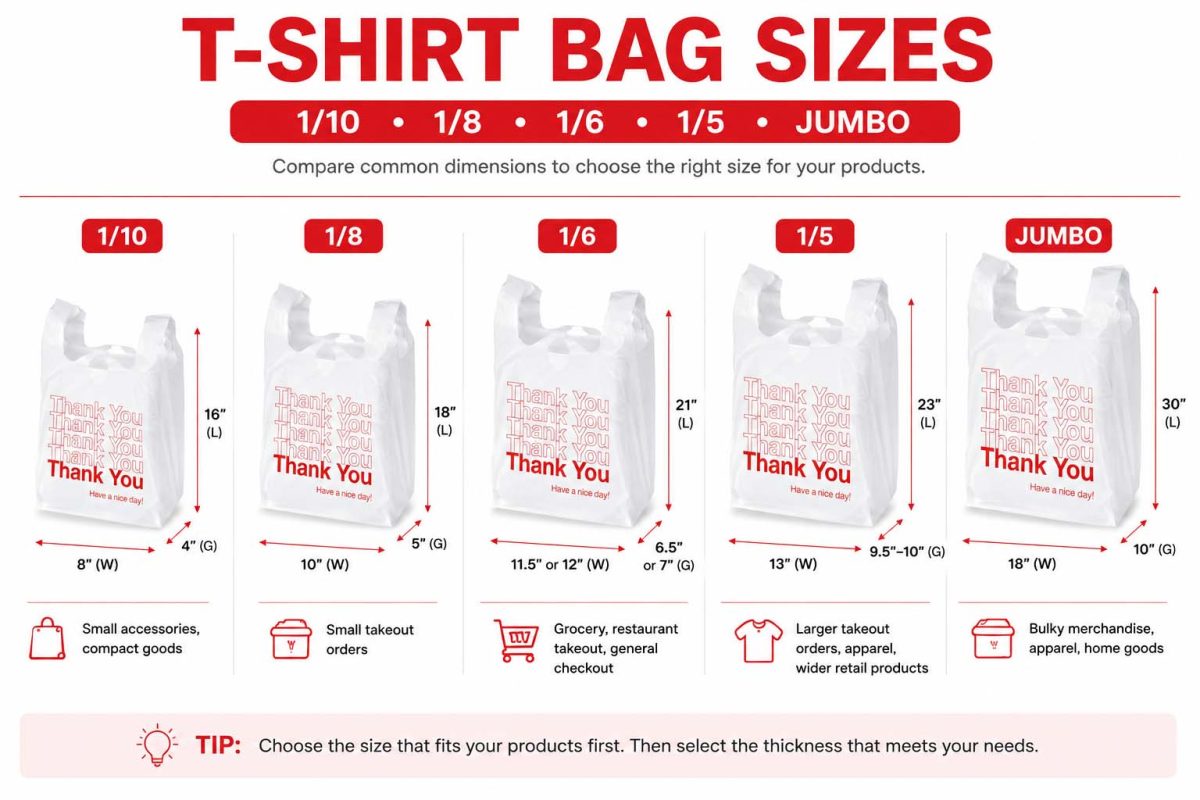
T-Shirt Bag Size Chart: 1/10 to Jumbo
The following t-shirt bag sizes are representative commercial dimensions rather than universal standards.
| Size Class | Representative Dimensions W × G × L | General Direction | Typical Starting Application |
|---|---|---|---|
| 1/10 | 8 × 4 × 16 in | Extra Small | Compact merchandise, packaged bakery items |
| 1/8 | 10 × 5 × 18 in | Small | Convenience, smaller takeout orders |
| 1/6 | 11.5 × 6.5 × 21 in or 12 × 7 × 22 in | Standard | Grocery, restaurant takeout, general checkout |
| 1/5 | Approx. 13 × 9.5–10 × 23 in | Large | Larger takeout orders, apparel, wider retail goods |
| Jumbo | Approx. 18 × 10 × 30 in | XL / Jumbo | Bulky merchandise and larger purchases |
This chart should help narrow the options, but it should not replace the actual specification.
A supplier may describe two products with the same size-class name while using slightly different widths, gussets or lengths.
Which T-Shirt Bag Size Fits Your Products?
The merchandise should drive the first sizing decision.
| Products Being Packed | Starting Size Direction |
|---|---|
| Small accessories or compact goods | 1/10–1/8 |
| Small takeout orders | 1/8 |
| General grocery or checkout purchases | 1/6 |
| Multiple food containers | 1/6–1/5 |
| Folded apparel or wider boxed products | 1/5 |
| Bulky merchandise or large multi-item orders | Jumbo |
These are starting points, not fixed rules.
For example, two restaurants may both use T-shirt bags but need different sizes because one packs a single small container while another regularly combines several wide takeout boxes.
Likewise, a clothing retailer may use a 1/6 for accessories but need a 1/5 or Jumbo for larger folded garments.
The best way to select t-shirt bag sizes is therefore:
Application → Actual Product Dimensions → Bag Size
rather than choosing from the industry name alone.
What Do 1/10, 1/8, 1/6 and 1/5 Mean?
The fractions are commonly used commercial size designations.
They are not inch measurements and they do not represent one fixed weight or capacity.
In general, the size progression is:
1/10 → 1/8 → 1/6 → 1/5 → Jumbo
This means a 1/6 bag is generally larger than a 1/8 bag, even though the fractions can look counterintuitive to a first-time buyer.
The fraction helps identify a general category. The actual dimensions still determine product fit.
1/8 vs 1/6 T-Shirt Bags: When Should You Size Up?
The 1/8 and 1/6 categories are especially useful to compare because both are widely used for smaller commercial purchases.
| Buying Question | 1/8 | 1/6 |
|---|---|---|
| General Class | Small | Standard |
| Representative Size | 10 × 5 × 18 in | 11.5 × 6.5 × 21 in / 12 × 7 × 22 in |
| Typical Direction | Smaller purchase | General commercial purchase |
| Usable Space | Less width, gusset and height | More room for larger or multiple items |
A 1/8 bag can work when the merchandise fits comfortably without forcing the bag open.
Move toward 1/6 when:
- products are wider;
- more side depth is needed;
- several items are normally packed together;
- additional usable height is required.
The goal is not to choose the largest t-shirt bag sizes available. It is to find the smallest practical size that fits the normal order without making packing difficult.
Why 1/6 Is a Common Commercial T-Shirt Bag Size
The 1/6 class sits in the middle of the common commercial size range, which is one reason it appears frequently across grocery, restaurant, convenience and retail products.
Representative specifications include:
11.5 × 6.5 × 21 in
and
12 × 7 × 22 in
A typical purchase-ready 1/6 listing may combine:
- exact dimensions;
- 1,000 bags per case;
- plain or Thank You print;
- T-shirt handle construction;
- grocery, takeout, restaurant and retail applications.
That approach is more useful for a buyer than showing only “1/6.”
A commercial specification should ideally answer:
How large is the bag, how is it packed, and what kinds of products is it intended to carry?
This is also why exact dimensions matter more than size-class terminology when comparing suppliers.
When Should You Move to 1/5 or Jumbo?
Moving to larger t-shirt bag sizes is mainly a space decision.
A 1/5 may be more appropriate when:
- several takeout containers are packed together;
- a box is wider than the usable space of a 1/6;
- larger folded apparel requires more gusset depth;
- multi-item retail orders regularly fill a standard bag.
Jumbo bags are the next direction for substantially bulkier merchandise, larger apparel purchases, home goods or other products requiring more overall space.
But a larger bag does not automatically require a thicker film.
Size determines fit. Thickness addresses another purchasing requirement.
Keeping those two decisions separate prevents buyers from automatically over-specifying the bag simply because the merchandise is physically larger.
How to Read T-Shirt Bag Dimensions
Commercial t-shirt bag sizes are commonly expressed as:
Width × Gusset × Length
For example:
12 × 7 × 22 in
Width
Width is the front-panel measurement.
For boxed products, food containers and wider retail merchandise, it is one of the first dimensions to check.
Gusset
The gusset is the folded side section.
When opened, it creates additional depth for products that are not flat.
A wider food container, for example, may require more gusset even when its height is relatively low.
Length
Length describes the vertical dimension of the bag.
However, buyers should confirm how the supplier measures it. Some product specifications include the handles in the overall length.
That creates an important distinction:
Overall Length ≠ Usable Interior Height
A bag listed as 22 inches long does not necessarily provide 22 inches of usable packing space below the handles.
For repeat B2B purchasing, comparing both overall size and usable size makes t-shirt bag sizes easier to evaluate across suppliers.
T-Shirt Bag Size and Thickness Are Different Decisions
The same bag dimensions can be produced in different film specifications.
Examples found across commercial product lines include:
| Example Thickness | How It Appears in Commercial Product Lines |
|---|---|
| Around 0.5 mil | Economy or lighter-use products |
| Around 0.65 mil | Standard or thicker HDPE options |
| 1.5 mil | Thicker LDPE / premium product lines |
| 2.25 mil | Extra-thick or reusable-style product lines |
These are market examples, not universal duty or regulatory classifications.
A 1/6 bag can therefore exist in several different thicknesses.
Thickness also does not determine load capacity by itself. Material, bag dimensions, handles, sealing and the products being carried all affect performance.
When selecting t-shirt bag sizes, first choose dimensions that fit the merchandise. Then evaluate thickness and material as separate specifications.
Choosing T-Shirt Bag Sizes by Business Application
Grocery and Convenience Stores
Smaller transactions may start around 1/8, while 1/6 is a common direction for general checkout.
Stores with a broad merchandise mix may find it more practical to keep more than one size rather than use the same oversized bag for every transaction.
Restaurants and Takeout
Takeout packaging should be matched to the outside dimensions of the food containers.
A small order may fit a 1/8.
A wider box or multiple containers may move the requirement toward 1/6 or 1/5.
For foodservice, gusset depth can be just as important as overall bag height.
General Retail
A 1/6 can cover many accessories and smaller general merchandise purchases.
Wider boxed products or larger multi-item transactions may require a 1/5.
Apparel and Larger Merchandise
Folded apparel and bulky merchandise may require 1/5 or Jumbo because they need more width, gusset depth or usable height.
The business type provides only the starting point. Final t-shirt bag sizes should be selected from the actual merchandise being packed.
How Many T-Shirt Bag Sizes Should a Business Stock?
Not every business needs the full 1/10-to-Jumbo range.
A business with a narrow product mix may be able to operate with one primary size.
A broader product range may justify a simple three-level system:
Small: 1/8
Standard: 1/6
Large: 1/5 or Jumbo
The purpose is not to carry more SKUs than necessary.
It is to avoid two common problems:
- using a bag that is too small for larger orders;
- using an unnecessarily large bag for routine smaller purchases.
For purchasing teams, reviewing a sample of normal transactions can help determine how many t-shirt bag sizes are actually required.
T-Shirt Bags, T-Sacks, Thank You Bags and Vest Bags
Different suppliers may use different names for the same general bag format.
T-Shirt Bag refers to the familiar handled plastic carryout shape.
T-Sack or T-Sack Bag is another industry term for this general format.
Thank You Bag usually refers to a T-shirt-style bag with a Thank You print. It does not have a separate size system.
Vest Bag is another common international name.
Grocery Bag is broader and describes the use rather than one exact construction.
So buyers comparing t sack bag sizes, thank you bag sizes, vest bag sizes or grocery bag sizes should still return to the same specification:
Width × Gusset × Length
The product name does not replace the physical dimensions.
Common T-Shirt Bag Size Buying Mistakes
| Common Mistake | Better Approach |
|---|---|
| Treating 1/6 as one exact dimension | Check W × G × L |
| Thinking 1/8 is larger than 1/6 | Compare the commercial size class |
| Choosing only by T-Sack or Thank You naming | Check actual dimensions |
| Using thickness to determine size | Treat mil and size separately |
| Ignoring usable height | Check whether handles are included in length |
| Using one bag for every purchase | Review the normal merchandise mix |
Frequently Asked Questions
What is a standard T-shirt bag size?
There is no single universal standard, but 1/6 is one of the most commonly offered commercial size classes.
Representative dimensions include 11.5 × 6.5 × 21 inches and 12 × 7 × 22 inches.
What does 1/6 mean on a T-shirt bag?
It is a commercial size designation rather than an exact inch measurement.
Always compare the actual width, gusset and length.
Is a 1/6 T-shirt bag larger than a 1/8 bag?
Yes. In common commercial sizing, 1/6 is generally larger than 1/8.
Actual dimensions may still vary by supplier.
What T-shirt bag size should I use for takeout?
It depends on the size and number of food containers.
Smaller orders may start around 1/8, while wider or multi-container orders may require 1/6 or 1/5.
What size is a Jumbo T-shirt bag?
There is no universal Jumbo specification.
Approximately 18 × 10 × 30 inches is one representative commercial size, but suppliers may offer different dimensions.
Choosing the Right T-Shirt Bag Size
The most reliable way to compare t-shirt bag sizes is to use the size class as a starting point and the actual dimensions as the final specification.
In general, 1/10 and 1/8 cover smaller purchases, 1/6 serves as a common commercial middle size, 1/5 provides more usable space for larger orders, and Jumbo covers substantially bulkier merchandise.
For repeat purchasing, start with the products being packed, compare the required width, gusset and usable height, and then select the material and thickness separately.
That approach turns t-shirt bag sizes from a naming system into a practical purchasing specification.