



Blog
Contractor trash bags are often purchased based on unit price, but the cheapest option does not always produce the lowest total job cost. Purchasing teams may focus on price per bag, while jobsite crews may assume that the thickest option is always the safest. Neither approach reliably controls operating expenses.
The true cost of contractor trash bags extends beyond the invoice. Breakage, double-bagging, replacement bags, cleanup labor, overloading, unnecessary thickness, and unstable supply can quickly erase the savings of a low unit price. The better purchasing decision is the specification that completes the job with the lowest total cost.
For professional buyers, the question is not simply, “Which bag is cheapest?” It is, “Which bag will handle our normal debris without failures, wasted material, or unnecessary labor?”
This guide compares 2 mil, 3 mil, and 4 mil options, explains when 3 mil contractor trash bags offer the best value, and shows how debris type and bag size affect real jobsite costs.
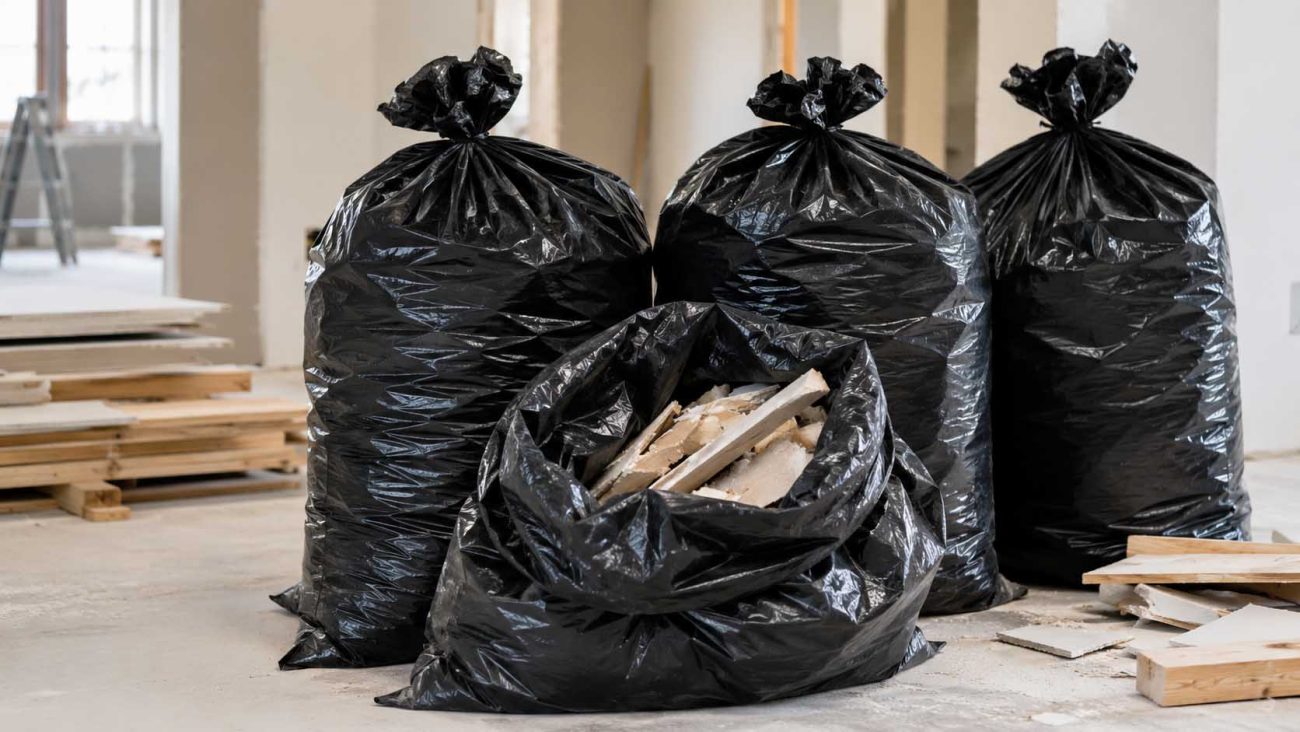
The Real Cost of Using the Wrong Contractor Trash Bags
A low-cost bag can become expensive the moment it reaches the field. If the specification is too light, crews consume more bags and spend more time correcting failures. If it is too heavy, the buyer pays for strength that the application never uses.
Bag Failure and Replacement Costs
When a bag tears, the loss is not limited to one piece of plastic. The crew must stop, collect the waste again, replace the damaged bag, and continue the job with less confidence in the product.
Even a small failure rate can become expensive across a large construction project, maintenance contract, or warehouse operation. The price difference between two specifications is often minor compared with repeated labor interruptions.
Double-Bagging Costs
Workers double-bag when they do not trust the product. This may reduce the immediate risk of a tear, but it also doubles consumption for that load.
A cheaper bag creates no real savings when two bags are required to perform the work of one. If double-bagging becomes routine, the quoted price per case no longer reflects the actual cost per completed task.
Cleanup and Labor Costs
A puncture or weak bottom seal can release drywall dust, wood pieces, roofing debris, or mixed waste across finished floors, hallways, parking areas, and loading zones.
The resulting cost includes additional sweeping, repacking, handling, and downtime. In many commercial environments, the labor required to recover from one failure costs more than the bag itself.
Over-Specification Costs
Buying the thickest available product for every application also wastes money. Packaging film, insulation, leaves, soft commercial waste, and other low-risk materials may not require 4 mil bags.
Over-specification raises the cost per unit and per case while adding plastic that provides little practical benefit. A stronger specification only saves money when the application actually needs it.
Overloading Costs
Capacity can create its own problem. Large bags are often filled until they are too heavy to lift safely or too dense for the bottom seal to support.
A 55-gallon bag may be efficient for bulky, lightweight debris, but it can become difficult to handle when filled with plaster, tile, concrete pieces, or roofing materials. In these cases, load control is often more important than adding thickness.
The central purchasing principle is simple: the lowest-priced bag can become the highest-cost option when it causes breakage, double-bagging, or additional labor.
How Mil Thickness Affects Contractor Trash Bags
One mil equals one-thousandth of an inch. Mil thickness affects material use, puncture resistance, tear resistance, and unit price, but it does not determine performance by itself.
Debris shape, weight, abrasion, bag size, seal quality, and handling method all influence the result. A thicker bag may reduce punctures, but it cannot compensate for excessive loading or unsafe handling.
The goal is to match the specification to the actual failure risk. That means using enough thickness to complete the job reliably without paying for strength the application does not need.
2 Mil vs. 3 Mil vs. 4 Mil Contractor Trash Bags
The following table provides a practical starting point for comparing common thicknesses.
| Thickness | Best for | Typical debris | Cost consideration |
|---|---|---|---|
| 2 mil | Light-to-medium cleanup | Packaging, insulation, leaves, soft scraps | Lowest cost when puncture risk is limited |
| 3 mil | General construction and renovation | Drywall, wood scraps, mixed jobsite debris | Strong balance of cost and performance |
| 4 mil | Sharp or demanding debris | Tile, glass, metal edges, roofing waste | Higher unit cost but fewer failures in severe use |
When 2 Mil Bags Reduce Costs
A 2 mil specification is often sufficient for lightweight debris with limited puncture risk. Packaging material, soft insulation, leaves, plastic film, paper waste, and general warehouse trash are common examples.
This thickness can reduce costs when loads are controlled, sharp objects are uncommon, and crews carry the bags rather than drag them across rough surfaces. In these conditions, upgrading every load to 3 mil or 4 mil may add cost without improving performance.
The key is to test the bag with real debris. A short field trial should include normal loading, lifting, carrying distance, and disposal methods.
When 3 Mil Bags Offer the Best Value
For many commercial construction and renovation applications, 3 mil contractor trash bags provide the most practical balance between puncture resistance, carrying strength, and price.
They are commonly used for drywall scraps, wood pieces, remodeling waste, mixed jobsite debris, and commercial cleanup. This thickness is especially useful when 2 mil bags require frequent double-bagging but 4 mil would be excessive for most loads.
The value comes from reducing failures without automatically moving to the highest-cost option. This specification is versatile, but it is not universal. Sharp metal, broken glass, tile, and highly abrasive waste may still require a heavier bag or smaller loads.
When Upgrading to 4 Mil Saves Money
4 mil contractor trash bags are better suited to aggressive debris with sharp edges, high abrasion, or repeated puncture risk.
Broken tile, shattered glass, metal offcuts, roofing shingles, and demolition waste can quickly defeat a lighter specification. In these applications, the higher unit price may be offset by fewer failures, less double-bagging, and lower cleanup labor.
The decision should still be evidence-based. If 3 mil bags already complete the job reliably, upgrading every application to 4 mil may increase cost without creating measurable savings.
Are 3 Mil Contractor Trash Bags the Best Value?
3 mil is a common starting point for general construction cleanup because it sits between low-cost lighter options and more expensive extra-heavy specifications.
When 3 Mil Is the Right Choice
This thickness is often appropriate for daily renovation work, drywall, wood scraps, mixed commercial debris, and moderate puncture risk.
It can be especially cost-effective when crews need one versatile specification for several general cleanup tasks. Compared with 2 mil, it may reduce double-bagging and minor punctures. Compared with 4 mil, it avoids paying for extra material on ordinary loads.
When 3 Mil Is More Than You Need
For cardboard, plastic wrapping, insulation, leaves, paper, and other soft waste, 3 mil may be more product than the job requires.
A properly selected 2 mil bag can offer better value when the load is light, smooth, and easy to carry. The savings become meaningful in high-volume operations where thousands of bags are consumed.
When 3 Mil Is Not Enough
Highly sharp, abrasive, or dense materials may exceed what this thickness can handle efficiently.
Broken ceramic tile, sharp metal, glass, and heavy roofing debris may justify a 4 mil option or a smaller load. The correct response is not always a thicker bag; it may also involve reducing capacity, changing the handling method, or separating sharp waste from general debris.
For many buyers, 3 mil contractor trash bags remain the best-value starting point, but the final decision should depend on debris type, load weight, and field performance.
Choose Contractor Trash Bags by Debris Type
Procurement decisions should begin with the waste itself. The same thickness can perform well in one application and poorly in another because the failure risk is different.
| Debris type | Main risk | Suggested starting point |
| Packaging and insulation | Low puncture risk | 2 mil |
| Drywall and plaster | Weight, dust, and irregular pieces | 3 mil |
| Wood scraps | Splinters and rough edges | 3 mil |
| Nails and metal pieces | High puncture risk | 3–4 mil |
| Tile and broken glass | Sharp edges | 4 mil |
| Roofing shingles | Weight and abrasion | 4 mil |
| Concrete and bricks | Excessive weight | Smaller controlled loads |
For high-density debris such as concrete, brick, or heavy plaster, thickness alone is not enough. The load should be reduced, the bag size should be controlled, and crews should avoid filling the bag to maximum volume.
A thicker product cannot eliminate every handling problem. It only addresses part of the risk.
How Bag Size Changes Total Cost
Bag size affects loading behavior, carrying weight, seal pressure, and crew efficiency. A larger bag is not automatically more cost-effective.
42-Gallon Contractor Trash Bags
A 42-gallon contractor trash bag is often a practical choice for denser construction waste. Its smaller capacity helps limit total load weight and reduces the temptation to overfill.
This size can improve manual handling, reduce pressure on the bottom seal, and make it easier for crews to move waste through hallways, stairways, and finished areas.
55-Gallon Contractor Trash Bags
A 55-gallon contractor trash bag is better suited to bulky, lightweight debris such as packaging, insulation, plastic film, and low-density commercial waste.
The larger capacity reduces bag changes and can improve cleanup speed. However, when filled with dense drywall, tile, concrete, or roofing debris, it can become difficult to lift and may place excessive stress on the seal.
The right size depends on debris density, target load weight, carrying distance, and handling method—not volume alone.
A Simple Method for Selecting Contractor Trash Bags
A repeatable selection process helps purchasing teams avoid over-specification and reduces inconsistency between jobsites.
- Identify the debris. Classify the waste as light and soft, mixed construction debris, sharp debris, or dense and heavy waste.
- Identify the primary failure risk. Determine whether puncture, tearing, abrasion, overloading, or seal failure is most likely.
- Choose the bag size. Consider debris volume, density, carrying distance, container size, and target load weight.
- Choose the lowest-cost reliable specification. Select the option that completes the job without routine breakage, double-bagging, or excessive labor.
- Validate the decision in the field. Test the product with actual debris and normal handling conditions before standardizing the purchase.
This approach is more reliable than selecting one specification for every application.
How to Calculate the Real Cost of Contractor Trash Bags
The most useful comparison is not cost per bag. It is cost per successful load or completed job.
Total Cost per Job = Bag Cost + Double-Bagging Cost + Replacement Bags + Cleanup Labor + Failure-Related Downtime
Consider two purchasing options.
Option A: Lower Price, Insufficient Specification
The quoted unit price is lower, but crews frequently double-bag. Some loads tear, product consumption increases, and cleanup takes longer.
Option B: Slightly Higher Price, Correct Specification
The quoted unit price is higher, but the bag handles the load reliably. Double-bagging falls, failures become rare, and crews complete cleanup faster.
Option B may cost more per bag and less per job.
This is why contractor trash bags should be evaluated by field performance, not invoice price alone.
Why Not All 3 Mil Contractor Trash Bags Perform the Same
Two products can carry the same nominal thickness and still perform differently. Manufacturing consistency determines whether the bag delivers the expected value across repeated orders.
Gauge Consistency
The film should maintain consistent thickness across the bag. Thin areas become weak points and may fail even when the nominal gauge appears adequate.
Seal Strength
Many failures begin at the bottom seal rather than through the film. Seal uniformity, production control, and heat consistency all affect load performance.
Dimensional Consistency
Variations in width, length, or opening size affect container fit, usable capacity, loading speed, and crew confidence.
Batch-to-Batch Consistency
A reliable product should deliver similar thickness, strength, dimensions, seal quality, and packaging count from one shipment to the next.
Inconsistent performance forces buyers to retest products, adjust procedures, or manage complaints across different jobsites.
Production and Supply Consistency
A stable supply program reduces emergency purchases, temporary substitutions, and repeated qualification work.
Supply interruptions can force buyers into higher-priced spot purchases or unfamiliar specifications. For ongoing commercial use, consistent production and delivery are part of the total cost equation.
Recommended Contractor Trash Bags by Application
Use the following recommendations as a practical starting point.
| Application | Suggested size | Suggested thickness |
| Light warehouse cleanup | 42–55 gallon | 2 mil |
| General renovation | 42 gallon | 3 mil |
| Construction jobsite cleanup | 42–55 gallon | 3 mil |
| Sharp demolition debris | 42 gallon | 4 mil |
| Roofing waste | 42 gallon | 4 mil |
| Bulky lightweight waste | 55 gallon | 2–3 mil |
| Heavy dense debris | Smaller controlled loads | 3–4 mil |
These are starting recommendations, not universal rules. Actual performance should be confirmed with real debris, normal loading behavior, and expected handling conditions.
Final Recommendation for Contractor Trash Bags
The best option is not automatically the cheapest, thickest, or largest bag available. It is the product that completes the task at the lowest total cost.
Use 2 mil for lightweight, low-risk waste. Start with 3 mil for general construction and renovation debris. Upgrade to 4 mil when sharp edges, abrasion, or repeated punctures justify the additional cost.
For dense materials, control bag size and load weight instead of relying on thickness alone. For repeat purchasing, evaluate gauge consistency, seal strength, dimensions, batch stability, and supply reliability.
The right contractor trash bags should reduce breakage, prevent unnecessary double-bagging, improve cleanup efficiency, and eliminate spending on strength the job does not require.
Frequently Asked Questions
Are 3 Mil Contractor Trash Bags Thick Enough?
For many general construction, remodeling, and mixed jobsite applications, yes. They are commonly suitable for drywall, wood scraps, and moderate puncture risk. Sharp glass, tile, metal, or highly abrasive debris may require 4 mil or smaller loads.
What Is the Best Mil for Contractor Trash Bags?
There is no universal best thickness. The correct mil depends on debris type, puncture risk, density, bag size, and handling conditions.
What Is the Difference Between 2 Mil and 3 Mil Contractor Bags?
2 mil is generally better for lightweight, low-puncture-risk waste. 3 mil provides greater puncture resistance and carrying strength for mixed construction and renovation debris, but it also costs more per unit.
When Should I Use 4 Mil Contractor Trash Bags?
Use 4 mil when handling sharp tile, broken glass, jagged metal, roofing materials, or demolition waste that repeatedly punctures lighter bags.
Are 42-Gallon or 55-Gallon Contractor Bags Better?
Neither size is better for every application. A 42-gallon bag helps control weight with dense debris, while a 55-gallon bag is efficient for bulky, lightweight waste.
Why Do Contractor Trash Bags Break?
Common causes include insufficient thickness, sharp objects, overloading, weak seals, uneven gauge, excessive dragging, and using a bag that is too large for dense waste.
How Can Businesses Reduce Contractor Trash Bag Costs?
Match the mil and size to the actual debris, validate products under real conditions, reduce double-bagging, control load weight, and compare total job cost rather than unit price alone.
Are All 3 Mil Contractor Trash Bags the Same?
No. Products with the same labeled thickness may differ in gauge consistency, seal strength, dimensions, packaging accuracy, and batch-to-batch reliability.